Unlocking the Future of Manufacturing Metal Parts with ThinkMetal™
Published on: 06-05-2024
Pioneering manufacturing metal parts with ThinkMetal™ using MFAM (Metal Fused Additive Manufacturing). We are on a mission to provide quick & cost-effective solutions for complex metal parts. Our goal is to enable industries with unparalleled design freedom, efficiency, and safety.
Metal Fused Additive Manufacturing (MFAM) is a process that uses a filament composed of metal powders bound together with polymer binder materials, enabling the printing of parts in materials such as stainless steel, copper, and Inconel. The filament is fed, heated and extruded through a nozzle, and deposited layer by layer, to form an object. The part is then debound and sintered resulting in a dense and strong metal part.
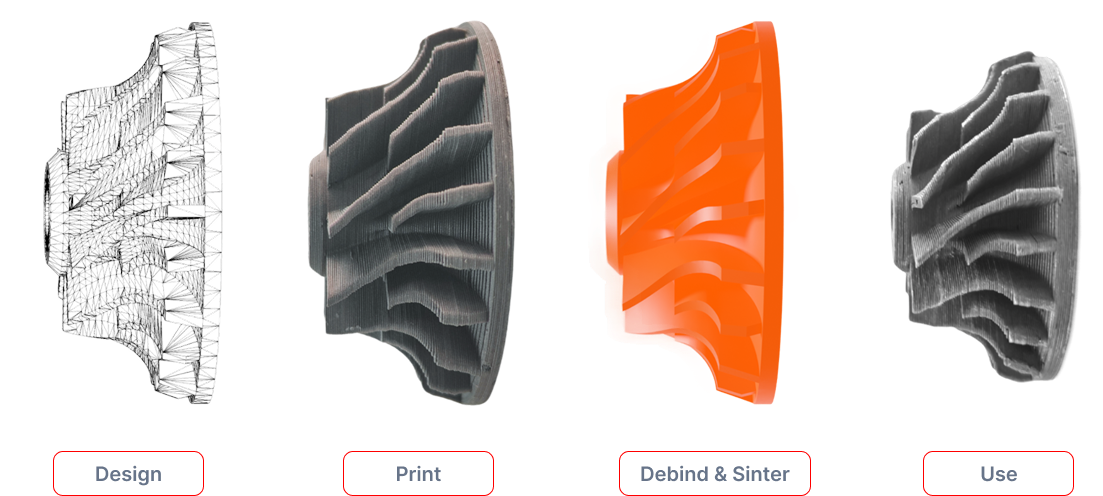
ThinkMetal™ MFAM process
MFAM offers several advantages over traditional manufacturing methods. It's cost-effective & provides exceptional design freedom, allowing for complex geometries like hollow structures and lattice patterns. Additionally, it allows for batch printing of multiple parts, saving time and materials.
MFAM Advantages
As the popularity of metal additive manufacturing grows by the day, there are several advantages companies are capitalising on. These are:
- Shorter Lead Times
- Freedom of Design
- Ability to Create Complex Parts
- Reduced Waste
- Excellent mechanical Properties
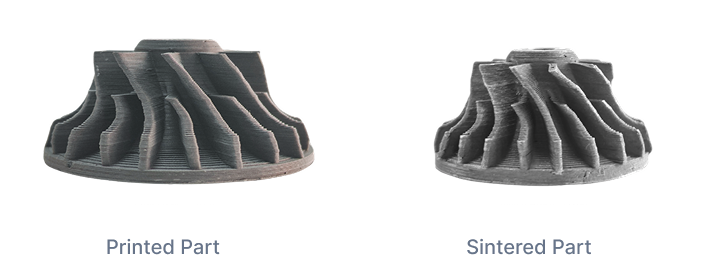
Impeller Manufactured on ThinkMetal™ systems
Shorter Lead Times
MFAM significantly reduces lead times compared to traditional manufacturing methods. From design to production, a part can be conceived, uploaded, and manufactured within a matter of hours, ultimately slashing lead times. This not only expedites the delivery of parts to customers but also minimizes equipment downtime, resulting in overall cost savings.
Freedom of Design
MFAM offers unparalleled design freedom. With minimal design constraints, virtually any concept can be transformed into a physical part through a 3D CAD model. This extensive design flexibility facilitates opportunities for design optimization and swift tooling and prototyping, enabling companies to swiftly iterate on designs, print tools and prototypes, and assess their functionality.
Ability to Create Complex Parts
One of the primary benefits of MFAM is its capability to produce parts with intricate geometries. Utilising a layer-by-layer approach, MFAM can replicate almost any part envisioned in a 3D CAD drawing with exceptional detail.
Reduced Waste
In an era where sustainability is increasingly paramount, MFAM stands out for its eco-friendly attributes. Unlike traditional manufacturing methods, MFAM minimizes waste by utilizing only the necessary material for each part. Moreover, up to 97% of the non-sintered raw material, such as metal powder, can be recycled, underscoring the sustainability credentials of Additive manufacturing technology.
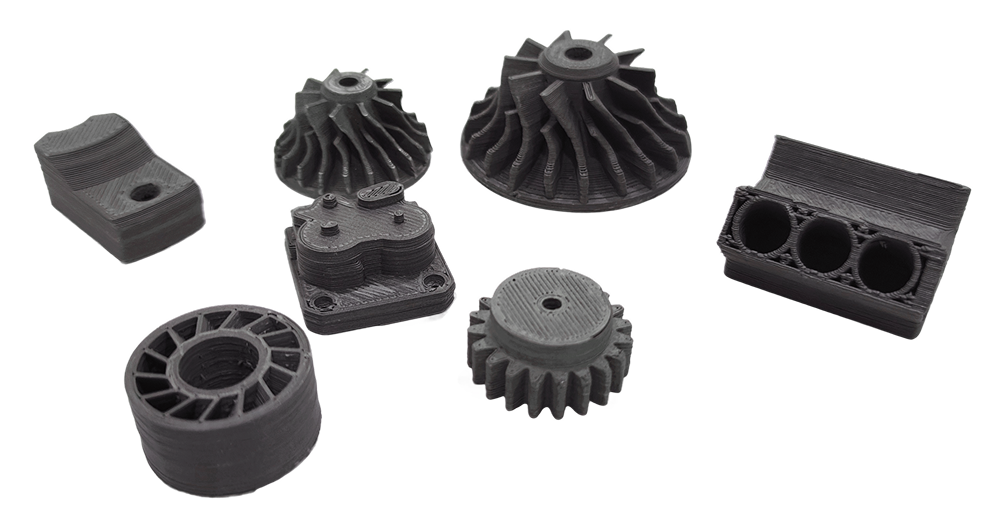
Green parts Manufactured on ThinkMetal™ systems
Excellent Mechanical Properties
The mechanical characteristics of manufactured parts largely depend on the additive manufacturing technology employed. Notably, MFAM is renowned for producing parts with near-isotropic mechanical and thermal properties. MFAM parts boast densities of up to 94.5%, surpassing those achieved through investment casting, and exhibit yield strengths nearly equivalent to machined parts. Furthermore, mechanical properties can be further enhanced through post-processing techniques, such as surface treatments and heat treatments.
In Conclusion
MFAM represents a paradigm shift in manufacturing, offering unparalleled capabilities in part creation, lead time reduction, design freedom, waste reduction, and good mechanical properties. While it may not completely replace traditional methods, it complements them, ensuring optimal manufacturing solutions tailored to specific job requirements.
Embrace the future of metal manufacturing with ThinkMetal™, where innovation meets excellence!
Stay tuned for more updates and insights on metal manufacturing!



Made In Bharat
@2026 by ThinkMetal. All rights reserved